→ return to THE news archive
Controlled protein degradation enables changes in metabolism
First published at UiB.no on November 25th, 2026
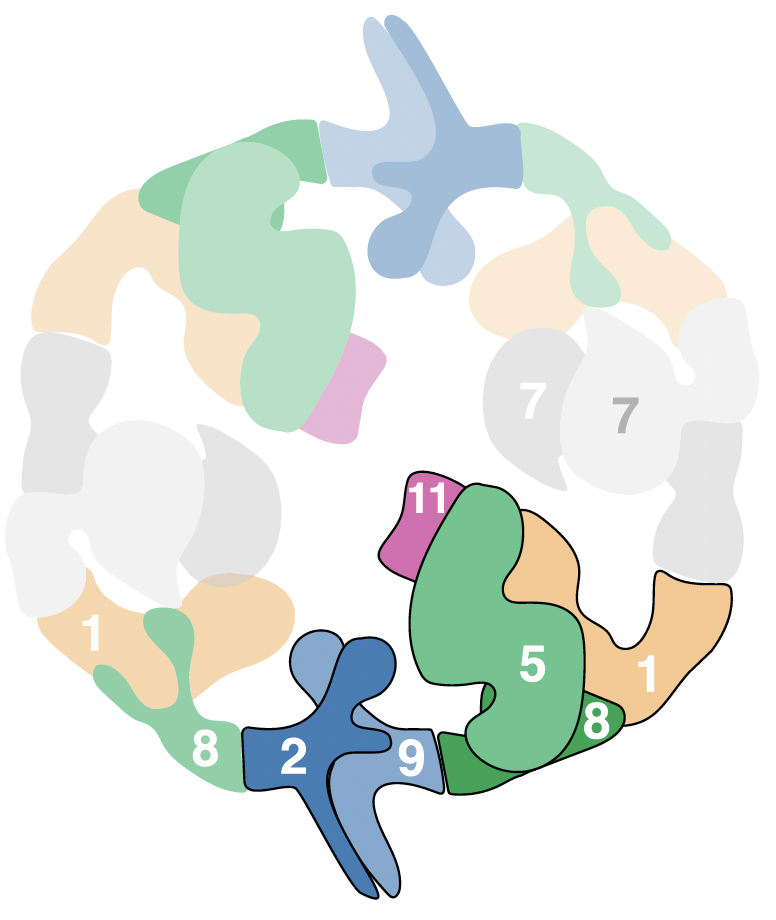
Cartoon of the putative GID-Gid11 ubiquitin ligase complex. Photo: Ka-Yiu Edwin Kong et al.
Cells must be able to control their metabolism to generate sufficient energy to function and to obtain building blocks for biosynthetic pathways. Changes in internal or external environment may require rapid changes in metabolic pathways.
To enable these changes, the cell needs to be able to control the expression of the metabolic enzymes in the cell through both protein synthesis and protein degradation. A new study conducted by the research group of Anton Khmelinskii at the Institute of Molecular Biology in Mainz, Germany with contributions from Matti Myllykoski and Thomas Arnesen at the Department of Biomedicine investigated these processes using yeast as the model organism.
When a yeast cell environment changes from glucose-rich to ethanol-rich, the cell needs to rapidly change its metabolism to utilize ethanol instead of glucose as carbon source. During this transition the metabolic enzymes specific to glucose processing are degraded, while enzymes that metabolize ethanol are synthesized. To identify the proteins that need to be degraded, the cells use specific recognition signals called degrons that are often found in the amino terminal end of the protein. Several types of such N-degrons have been reported. The degrons are identified by the specific substrate recognition components of ubiquitin ligase complexes that then mark the proteins with ubiquitin for degradation.
It was previously shown that when a yeast cell switches from ethanol to glucose as a carbon source, it uses the GID (Glucose-induced degradation deficient) ubiquitin ligase complex with the Gid4 substrate recognition component to identify and mark for degradation proteins that start with a proline residue, or Pro/N-degrons. Here, the authors show that during the reverse change, from glucose to ethanol as carbon source, the yeast cell again uses the GID complex, but this time the substrate recognition is done by another protein called Gid11. Although Gid11 itself and its interactions with the GID complex are shown to resemble Gid4, it is functionally different in that it prefers to recognize proteins starting with threonine, or Thr/N-degrons. In effect, changing the substrate recognition component enables the GID ubiquitin ligase complex to target a different set of proteins, those that have evolved to have a threonine as an amino terminal residue.
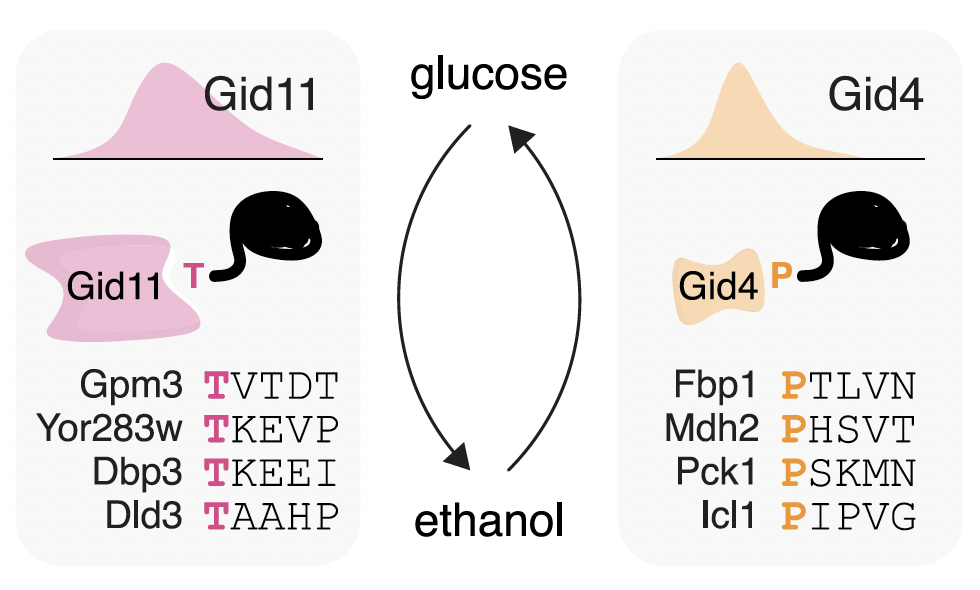
Model of the GID-mediated bidirectional control of the switch between glucose and ethanol as carbon source. Photo: Ka-Yiu Edwin Kong et al.
Cellular proteins undergo various types of enzymatic modifications during or after translation such as acetylation or phosphorylation. Depending on the situation, these modifications may protect a protein from identification by the cellular degradation machinery or expose the protein to it. Proteins with a threonine residue at the amino terminus are often N-terminally acetylated during translation by the NatA acetyltransferase complex. The authors show that the acetylation prevents the recognition of the Thr/N-degron by Gid11 and subsequently protects the protein from degradation. However, the authors found that both the recognition of the amino terminal sequence by Gid11, and the acetylation of it by NatA, are dependent on the residues following the initial threonine, and the two preferences are opposite to each other: Sequences identified by Gid11 are not acetylated by NatA, and sequences acetylated by NatA are not identified by Gid11.
In summary, this new study highlights how the necessary cellular metabolic control is enabled by the variable N-degron recognition components that are fundamental to the protein degradation machinery.